Client: Greyfriars Kirk, 2026
Summer 2026 saw the unveiling of an exhibition about Greyfriars Kirkyard, one of Edinburgh’s most visited attractions. The new display celebrates the kirkyard’s stories and remembers just a few of the many thousands of people who are buried there.
CMC worked closely with the Greyfriars team to honour these lives in the new display, while respecting the kirk as a spiritual and architectural space. Tourists regularly walk through the kirkyard while visiting the Edinburgh Old Town and part of the brief was to entice a few more inside where they can also appreciate the kirk’s understated yet beautiful interior and dedicated museum.
The new exhibition connects indoor and outdoor, kirk and kirkyard, and places the Greyfriars story firmly within that of the wider the city.
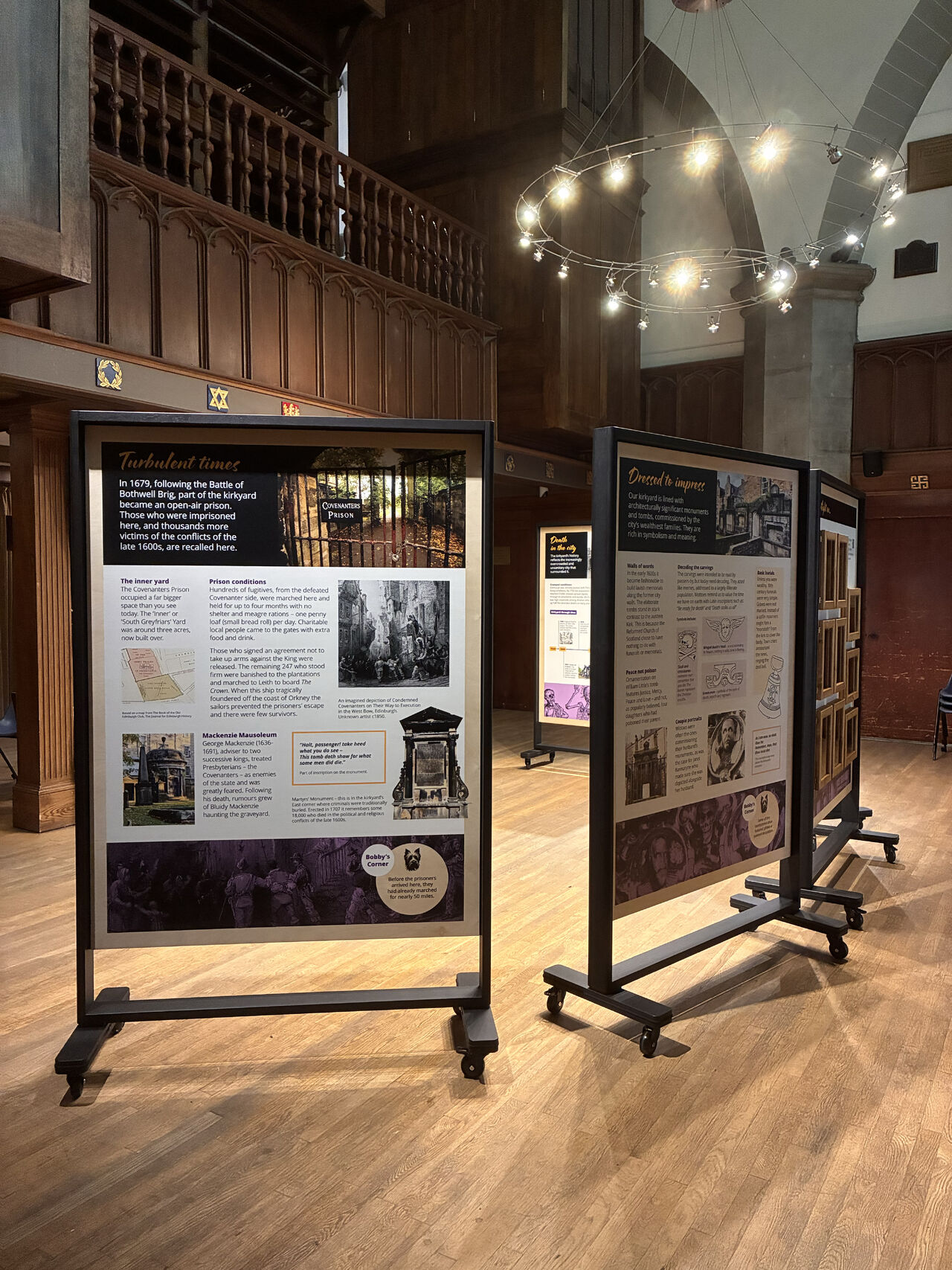
Thanks to thoughtful design, borrowing colours and details from the kirk interiors, coupled with expert craftsmanship, the resulting free-standing panels have a robust and high-quality finish and look very much at home within the space. When the space is needed for church events they can be easily stowed away.
Early reports from the client indicate that they are extremely happy with the results and are getting a lot of positive feedback from their visitors.
Finding the hooks
Our client told us that there are three words that tourists currently connect with Greyfriars: “Bobby, Potter” and “poltergeist”. The brief was to go beyond these, to bring out more about its links to wider history such as the Scottish Enlightenment and the National Covenant – to let the kirkyard tell its own story.
The Kirkyard is, of course, best known for the little dog Greyfriars Bobby who has become a worldwide symbol for devotion for tending his master’s grave. Characters from the Harry Potter novels appear on tombstones, and many an Edinburgh ghost tour makes a special stop to tell people about the haunted tomb of Bluidy Mackenzie.
It still felt important to retain these popular topics as touchpoints, including did-you-know boxes on each panel which share factoids introduced by the terrier Bobby.

Choosing the stories
How does one sum up a place as rich in history as Greyfriars kirkyard? Deciding what to cover was no mean feat with a history stretching back to medieval times, at least 700 headstones, and around 200,000 burials.
We were lucky to have an excellent kick start by way of a fascinating tour from Mark Hatton of Friends of Greyfriars Kirkyard. Then through a workshop with the kirk community, we collaboratively shaped the exhibition plan, looking to capture the spirit of place and agree which stories to prioritise. We distilled this further through a collaborative process of research and content planning. The resulting panels are loosely chronological. Each takes on one core theme from the kirk’s story, with a selection of characters and key events highlighted along the way.
Hidden depths
This exhibition client represents a religious community and it felt important to reflect their values in the display. The kirk prides itself on projects that give vulnerable people a second chance or a stepping stone, underpinned by a belief that that everyone has value in this world.
This idea that however many thousands of people might be buried here that each of these people counted underpinned the approach we took.
The kirk’s strapline An Inspiring Community also led to us look out for individuals who had made impressive achievements such as enlightenment thinkers including James Hutton and hidden heroes like school-founder Annie Reid.
This line of thinking also flagged up complexity and nuance, which we worked with our client to navigate, ensuring they were comfortable with whatever messages were presented. The graveyard’s usage coincides with the peak of Scotland’s involvement in Transatlantic Slavery. Also, some of those who supported the Covenanters during the 1600s were the same people persecuting women as witches, and vice versa the allegedly cruel ‘Bluidy’ Mackenzie actively helped abolish the witch trials. That’s all aside from how very few women are properly represented within the memorials.
There is so much more to be explored than we could begin to cover, but these areas represent rich avenues for future research. Perhaps these are some of the topics that might appear on the additional panel as kirk staff and volunteers find out more in the future.
Design
The graphic design carefully acknowledges colours and features used within the kirk’s interiors – when we first set foot inside, there was sunlight streaming through its colourful stained-glass windows. The look and feel also ties in with the kirk’s branding and complements, without copying, the graphic approach used in the existing museum.
Pops of colour were added to bring life to the displays. The client was keen to stress that the kirkyard is not just a place of the dead, but somewhere that is used by and valued by the living, over and above being part of a place of worship. We made sure to include colourful and contemporary images, ensuring it wasn’t all black and white.
The kirkyard is mentioned in numerous antiquarian books about old Edinburgh and has been depicted by various artists over the years. We were lucky to unearth some fantastic archival images, over and above those supplied by the kirk librarian. Very few people in this timeframe had portraits made but we did our best to visually represent them and used feature quotes to inject some personality and bring emotional connection.
So that the 3d built elements befitted this impressive architectural space they were bespoke designed and built by an expert craftsman Alasdair Campbell. We selected high-quality natural materials that complement the existing wooden structures within the historic kirk.

Flexibility for the future
We had to be aware of flexibility on several fronts. One early decision was to leave one panel that the team could use to feature temporary displays as future research arises, or to promote events to congregation members. Clip frames have been integrated to encourage a tidy and professional appearance.
The panels are built so that the team can change the display to maximise use of space and a nesting system means they have a minimal footprint when stored.
Marrying quality and flexibility can be a challenging ask. In this case, we are proud to have created something easy-to-stow-away that sits very comfortably within a historic and sacred architectural space.
They look absolutely at home in their intended setting and their immediate appeal to visitors evident; and when not in use they are stacking away tidily, exactly as intended.
Thank you so much for getting our exhibition panels through to completion: from distilling down the mass of information and partly formed ideas that we supplied, to finding the images, refining the layout and piloting the panels through production.
Jo Elliot, Session Clerk, Greyfriars Kirk